
The legal battle over marijuana in Florida has entered a new chapter as the state’s Attorney General, James Uthmeier, has formally requested the Florida Supreme Court to review the constitutionality of a proposed 2026 ballot initiative. The court has accepted the petition and established a fast-tracked briefing schedule for early next year.
The Path to the Ballot
The advocacy group Smart & Safe Florida announced last month that it had successfully gathered over one million signatures. Despite this milestone, the campaign has faced significant friction with state officials:
-
Certification Delays: Activists previously sued the state to expedite the signature verification process.
-
Signature Disputes: Approximately 200,000 signatures were recently flagged as invalid by state regulators, leading to further legal tension.
-
Legal Scrutiny: The current Supreme Court review will focus on whether the ballot’s language and summary are clear and adhere to single-subject rules required by the state constitution.
Political Headwinds
Governor Ron DeSantis remains a vocal critic of the movement. While a 2024 version of the amendment gained a majority of the vote, it failed to reach the 60% supermajority required for passage in Florida.
DeSantis has argued that such policies do not belong in the state constitution, suggesting instead that the issue should be handled by the legislature. He has predicted “big time trouble” for the measure’s survival in court, though he made similar predictions about the 2024 version which the court ultimately allowed to proceed.
Strategic Adjustments
Smart & Safe Florida—backed heavily by industry leaders like Trulieve—has revised the 2026 proposal to address common criticisms from the previous cycle. Key changes in the new version include:
-
Public Use Bans: Explicit language prohibiting the smoking or vaping of marijuana in public spaces.
-
Legislative Oversight: New provisions giving the legislature clear authority to regulate the “time, place, and manner” of consumption.
Public Sentiment and Restrictions
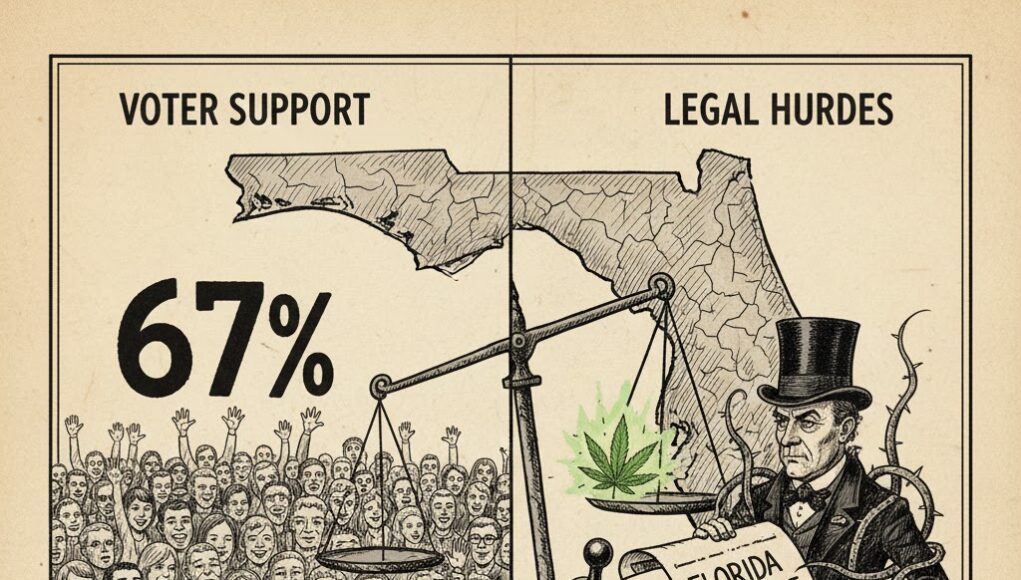
Despite the executive opposition, public polling suggests the reform remains popular across party lines. A February survey indicated that 67% of Florida voters support legalization, including a majority of Republicans and Independents.
However, other state-level actions continue to tighten the reins on the existing medical program. Under recent budget legislation signed by DeSantis, the Department of Health is actively revoking medical marijuana registrations for patients and caregivers who have certain drug-related criminal records.
As the January court deadlines approach, the future of the 2026 initiative rests on whether the judicial branch views the updated language as a fair representation of the law to the voters.