
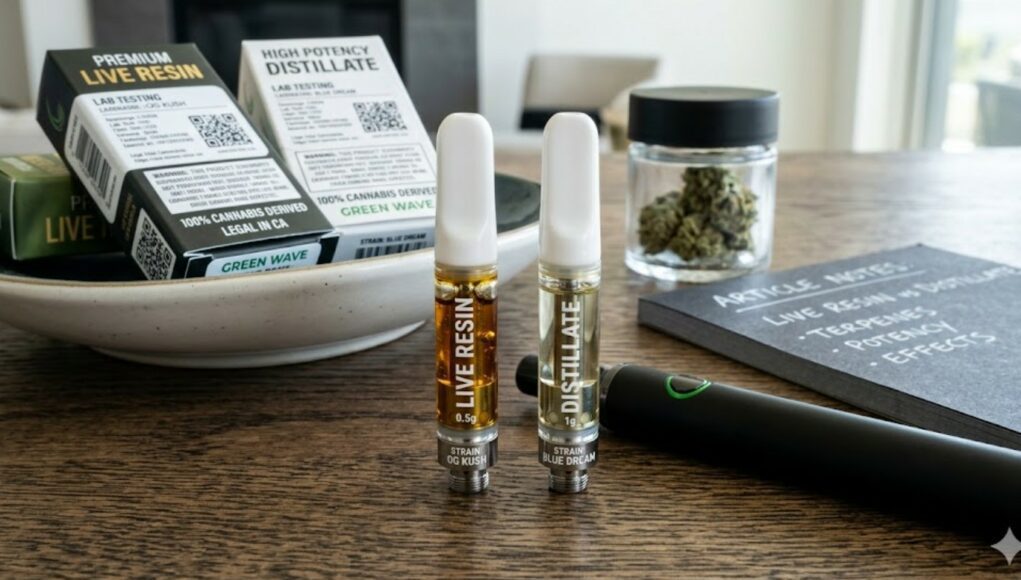
The live resin vs distillate cart dilemma hits you every time you stare at two vape options in a shop and wonder why one costs 30% more than the other.
Both fit the same 510 battery. Both look like amber oil in a glass tube. The price difference is real, and so is the difference in what you actually experience.
Here is a clear breakdown of what separates these two extract types, what that means for your high, and how to decide which one fits your needs.
What Is a Distillate Cart?
Distillate is cannabis oil refined to near-pure THC through multiple processing stages:
- Solvent extraction: Dried, cured flower is extracted using ethanol or CO2
- Winterization: Cold filtration strips out fats and waxes
- Decarboxylation: Heat activates the cannabinoids
- Short-path distillation: Separates and purifies the target cannabinoid
The result is a clear, odorless oil that typically runs between 85% and 99% THC.
The tradeoff is that nearly everything else gets removed in the process: terpenes, minor cannabinoids, and flavonoids. Because the oil has no natural flavor left, manufacturers add terpenes back in after extraction. These can be cannabis-derived or botanical (sourced from citrus peels, pine, and similar plants).
Who distillate works best for:
- Budget-conscious buyers who want maximum THC per dollar
- Users who prefer consistent, predictable effects from session to session
- Anyone who wants low odor and discreet use
What Is a Live Resin Cart?
Live resin skips the drying and curing steps that most concentrates go through. Instead:
- Freshly harvested cannabis is flash-frozen immediately after harvest
- The frozen material is extracted using hydrocarbon solvents like butane or propane
- Because the plant compounds are preserved before degradation, the extract mirrors the original strain’s chemical profile
Live resin carts typically run between 70% and 95% THC, slightly below distillate, but carry a much richer profile of natural terpenes and minor cannabinoids. That full-spectrum content is why live resin smells and tastes like the actual strain: earthy, piney, citrusy, or funky,, depending on what was grown.
Who live resin works best for:
- Flavor-focused users who want strain-accurate taste
- Experienced consumers who value a full-spectrum effect
- Anyone with a battery that has adjustable voltage control
Live Resin vs Distillate THCA Carts
THCA (tetrahydrocannabinolic acid) is the precursor to Delta-9 THC. In raw form, it is non-intoxicating, but heat converts it to THC through decarboxylation. THCA carts have grown in the hemp market because THCA falls outside the 0.3% Delta-9 threshold under the 2018 Farm Bill, while still delivering potent THC when vaped.
Key characteristics of THCA carts:
- Available in both live resin and distillate-style formats
- Extraction method still determines whether you get a full-spectrum or isolated experience
- Lab-verified COAs are especially important since the THCA market is less regulated than licensed dispensaries
For anyone looking at legal hemp-derived options, thca vape carts are worth reviewing before picking any THC-based format, as the same live resin vs distillate tradeoff applies here.
The Entourage Effect: Why It Matters for Carts
The entourage effect is the theory that explains how cannabinoids and terpenes work better together than any single compound does alone. Research suggests terpenes interact with THC receptors in ways that improve the intensity and longevity of the high.
In practical terms:
- A distillate cart at 95% THC can hit hard but feel flat or one-dimensional to experienced users
- A live resin cart at 80% THC can feel more rounded and longer-lasting, because the terpene profile is working alongside the THC
That said, some users prefer the clean, predictable punch of distillate. Others find the entourage effect from live resin is exactly what they want.
Head-to-Head Comparison
| Factor | Distillate Cart | Live Resin Cart |
| THC Potency | 85-99% | 70-95% |
| Terpene Profile | Added after extraction (artificial or botanical) | Natural, retained, and strain-accurate |
| Flavor | Built; varies by brand | Authentic to the strain |
| Price | Lower | 20-40% higher |
| Aroma | Low odor | Strong cannabis scent |
| Best Voltage | 2.8-3.6V | 2.2-3.0V |
| Entourage Effect | Minimal | Full |
Voltage tip: Live resin is heat-sensitive. Running it too hot burns off the terpenes before you taste them. A battery with adjustable voltage settings makes a real difference with live resin carts.
Price vs. Experience: How to Choose
Go with distillate if:
- You want the highest THC concentration per dollar
- Consistent, predictable effects matter more than flavor
- Discretion is a priority (lower odor)
- You are new to vaping and want straightforward dosing
Go with live resin if:
- Strain-accurate flavor matters to you
- You want the entourage effect from a full-spectrum profile
- You are comfortable paying 20-40% more for the experience
- You have a battery with voltage control
A note on quality: A poorly made live resin cart from low-grade starting material will underperform a well-made distillate cart every time. Always check the certificate of analysis (COA) before buying: it should confirm cannabinoid percentages and screen for pesticides, residual solvents, and heavy metals. The best thca carts in 2026 all share one trait: transparent, up-to-date third-party lab reports.
Final Thought
Live resin and distillate carts are built for different priorities. Distillate is engineered for potency and consistency. Live resin is engineered to preserve the plant.
Figure out what you are actually after in a session, check the COA, and pick the format depending on your battery’s capabilities.